Pulkovo EOP and Reference Systems Analysis Center (PERSAC)
The scientific and civil society communities primarily use three time scales: Universal Time (UT1), International Atomic Time (TAI), and Coordinated Universal Time (UTC). UT1 is an astronomical time scale defined by the Earth's spin. It is non-uniform due to the complexity of the Earth's rotation. TAI is a uniform time scale, but the difference TAI-UT1 increases over time, from about 1.4 s in 1961 to about 37 s now. UTC is a compromise time scale which has the same uniform rate as TAI but differs from TAI by an integer number of seconds (after January 1, 1972), so that the absolute difference UT1-UTC should never exceed 0.9 s. This is achieved by introducing leap seconds at the end or middle of the year to compensate for the accumulated difference between TAI and UT1. For more details, see [1-3].
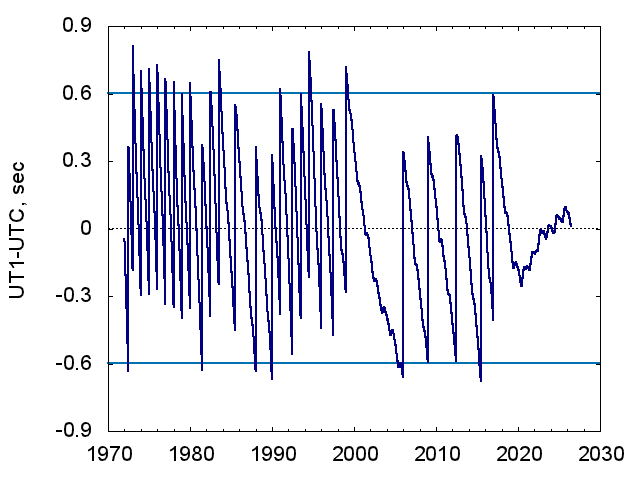
Figure 1 shows that since the introduction of UTC, the Earth's rotation slowed down for several decades, causing regular introduction of positive leap seconds into UTC, which, though inconvenient, became routine for users. However, in about 2020 Earth began to accelerate, which may necessitate introducing for the first time a negative leap second into the UTC scale, which may have a very serious impact on many practical applications.
| Fig. 1. Observed UT1-UTC change since 1972. The light blue lines indicate the approximate tolerances above (below) which the IERS may decide on introducing a new leap second. When UT1-UTC became smaller than about -0.6 s, IERS introduced a positive leap second. If UT1-UTC would exceed about +0.6 s, IERS may introduce a negative leap second. Each one-second step on the plot corresponds to a positive leap second. A negative slope (decreasing) of UT1-UTC between the leap seconds corresponds to a slowdown in Earth's rotation, a positive slope (increasing) of UT1-UTC after 2020 corresponds to speeding up Earth's rotation. | |
In [3], the author performed a detailed investigation of the UT1-UTC series for 1962-2024 and, based on this research, made the following assumption: "The current UT1 prediction suggests that the period of acceleration of the Earth's rotation should end within the next two years and will most likely be replaced by a slowdown". That is, the turning point was predicted for around 2026. This page is intended for monitoring current operational data related to UT1-UTC changes to test how well the forecast made in 2024 holds up.
It can be seen in Fig. 2 that the positive slope in UT1-UTC gradually decreased between 2020 and 2026, and the predictions indicate that Earth is likely entering a new period of slowing its rotation, and that UT1-UTC is expected to return to a negative slope soon. Another indicator may be annual extremes in UT1-UTC, which can be usually observed in September-October (maximums) and in May-June (minimums) of the year. The currently observed minimum is below the previous one, which is happening for the first time since 2020, and the minimum in 2027 is predicted to be lower than the current minimum. The same can be said about the next predicted maximum in September 2026, which is expected to be lower than the previous maximum in 2025. In particular, current predictions indicate that the introduction of a negative leap second during nearest years appears rather unlikely at the moment.
| Fig. 2. UT1-UTC behavior during last years. This plot also includes one-year prediction made in the IERS/USNO, two-year prediction computed by the author, and moving yearly average. | 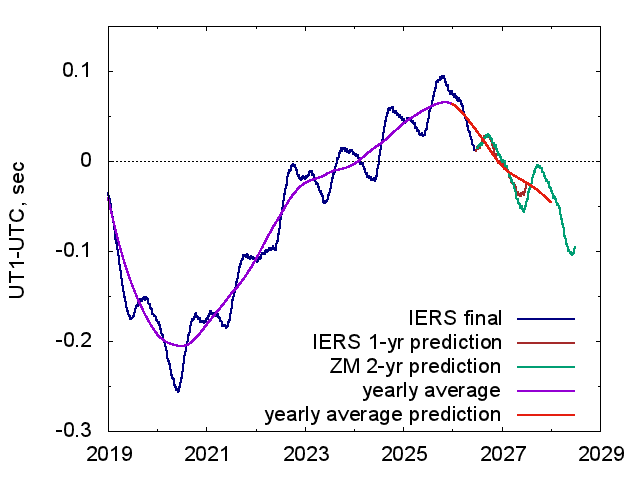 |
As a matter of fact, changes in the UT1 rate are caused by changes in the Earth's rotation speed, which can also be measured by observing the length of day. Conventionally, Earth rotation services publish a LOD value which is the difference between the observed length of day and its nominal value of 86,400 s. Although LOD and UT1 are determined from observations independently of each other, they are closely connected. Positive LOD corresponds to deceleration of Earth's rotation relative to TAI, while negative LOD corresponds to acceleration of Earth's rotation relative to TAI. If average LOD were always at zero level, the Earth's rotation velocity would be constant in average, showing only seasonal variations, and the difference UT1-UTC would fluctuate around constant or zero, depending on the definition of UTC. Fig. 3 presents the LOD variations since 2019.
| Fig. 3. LOD behavior during last years. It can be observed that the yearly average LOD becomes negative in 2020, which has led to an increase in the Earth's rotation speed relative to the TAI rate and, consequently, to an increase in the UT1-UTC in the years after 2020. However, recently, the yearly average LOD turned positive for the first time since June 2020 and continues to grow. This may indicate that Earth is entering a new period of slowing its rotation, as was also illustrated by the variations in UT1-UTC discussed above. | 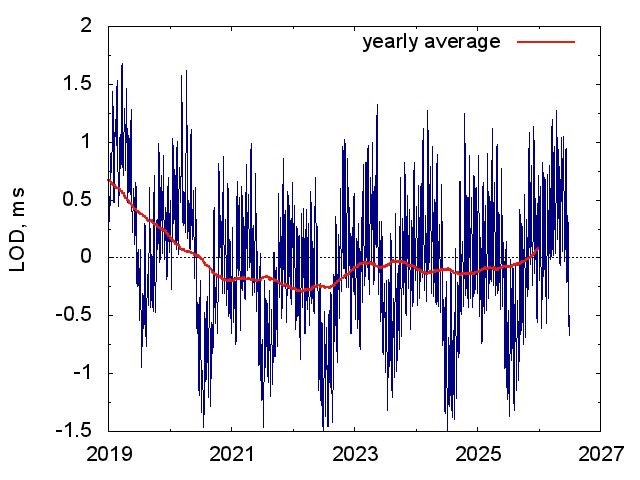 |
The results presented at this page are based on the data provided by the International Earth Rotation and Reference Systems Service (IERS) and the U. S. Naval Observatory (USNO).
[1] Nelson R.A., McCarthy D.D., Malys S, Levine J, Guinot B, Fliegel HF, Beard RL, Bartholomew TR (2001) The leap second: its history and possible future. Metrologia, 38(6), 509-529. https://doi.org/10.1088/0026-1394/38/6/6
[2] Panfilo G., Arias F. (2019) The Coordinated Universal Time (UTC). Metrologia, 56(4), id. 042001. https://doi.org/10.1088/1681-7575/ab1e68
[3] Malkin Z.M. (2024) Should We Expect Further Acceleration of the Earth's Rotation in the Coming Years? Astronomy Reports, 68(10), 1022-1028. https://doi.org/10.1134/S1063772924700884
| Contact: Zinovy Malkin, e-mail: malkin@gaoran.ru, web: zmalkin.com |
 |